

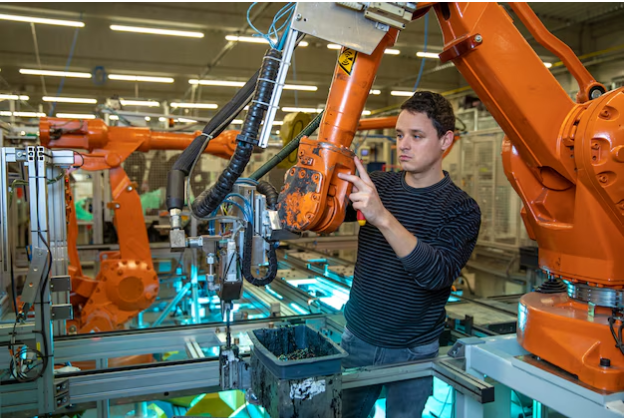
The manufacturing industry is undergoing a profound transformation, driven by technological innovations and the advent of smart factories. These highly automated and interconnected production environments are revolutionizing traditional manufacturing by enhancing efficiency, productivity, and adaptability. In this article, we explore the rise of smart factories, the technology behind them, and their impact on the industry.
What Are Smart Factories?
Definition of Smart Factories
A smart factory is a digitized manufacturing facility that leverages advanced technologies like artificial intelligence (AI), the Internet of Things (IoT), robotics, and big data analytics. These technologies enable seamless communication between machines, systems, and humans, allowing for real-time decision-making and optimization.
Key Features of Smart Factories
- Automation: Machines perform repetitive and complex tasks with minimal human intervention.
- Interconnectivity: Devices and systems communicate through IoT-enabled networks.
- Data-Driven Decision-Making: Insights from big data analytics improve processes and outcomes.
- Flexibility: Production lines can quickly adapt to changes in demand or design.
The Technology Powering Smart Factories
1. Internet of Things (IoT)
IoT connects machinery, sensors, and systems, enabling real-time monitoring and communication. This technology helps manufacturers:
- Track performance metrics.
- Predict maintenance needs.
- Minimize downtime through proactive interventions.
Get more briefs on technology advancements for small businesses from the blogs on lbsinsight.com.
2. Artificial Intelligence (AI) and Machine Learning (ML)
AI and ML algorithms analyze massive amounts of data to uncover patterns and trends. In smart factories, these technologies:
- Automate quality control through visual inspections.
- Optimize supply chains by predicting demand fluctuations.
- Enhance production scheduling for efficiency.
3. Robotics and Automation
Advanced robotics take automation to new heights, performing tasks that require precision, consistency, and speed. Collaborative robots (cobots) work alongside humans to:
- Increase production speed.
- Improve workplace safety.
- Handle hazardous or repetitive tasks.
4. Cloud Computing
Cloud platforms store and process vast amounts of data generated by smart factories. Benefits include:
- Centralized data management.
- Scalable computing power.
- Seamless integration across global operations.
5. Big Data Analytics
Data collected from IoT devices and factory systems is analyzed to:
- Identify bottlenecks.
- Optimize resource allocation.
- Improve product quality.
Advantages of Smart Factories
1. Enhanced Efficiency and Productivity
Smart factories eliminate inefficiencies by automating processes, reducing waste, and ensuring machines operate at peak performance. This results in:
- Faster production cycles.
- Lower operational costs.
- Better utilization of resources.
2. Real-Time Insights
The ability to monitor operations in real-time allows manufacturers to make informed decisions quickly. Predictive maintenance, for instance, ensures equipment remains functional, preventing costly breakdowns.
3. Customization and Flexibility
Smart factories enable mass customization, allowing manufacturers to produce personalized products at scale without compromising efficiency. Flexible production lines can switch between different products seamlessly.
4. Improved Product Quality
Suggestions from LBS Insight on automated quality checks and AI-driven insights ensure consistent production standards, reducing defects and enhancing customer satisfaction.
5. Sustainability
By optimizing energy consumption and minimizing waste, smart factories contribute to environmental sustainability. Advanced systems monitor energy usage and suggest ways to reduce the carbon footprint.
Challenges Facing Smart Factories
1. High Implementation Costs
The transition to a smart factory involves significant investment in technology, infrastructure, and workforce training. This can be a barrier, especially for small and medium-sized enterprises (SMEs).
2. Cybersecurity Risks
The increased connectivity in smart factories makes them vulnerable to cyberattacks. Manufacturers must invest in robust security measures to protect sensitive data and systems.
3. Workforce Transition
Automation and AI may replace certain roles, necessitating retraining for workers to adapt to new responsibilities. Balancing technology adoption with job preservation is a critical challenge.
4. Integration Complexity
Integrating legacy systems with new technologies can be complicated and time-consuming. Ensuring compatibility and seamless communication between systems is essential.
Real-World Examples of Smart Factories
1. Siemens’ Digital Factory
Siemens has embraced smart factory technologies at its Amberg Electronics Plant in Germany. The facility uses AI, IoT, and robotics to achieve nearly 100% automation and zero defect rates.
2. General Electric (GE)
GE’s Brilliant Factories utilize data analytics and predictive maintenance to enhance productivity. Their smart factories report a significant reduction in unplanned downtime.
3. Tesla
Tesla’s gigafactories are a prime example of smart factories. They integrate advanced robotics, machine learning, and IoT to produce electric vehicles and batteries efficiently.
The Future of Smart Factories
1. Growth of AI-Driven Automation
AI will continue to play a pivotal role, enabling greater autonomy and decision-making capabilities in factory operations.
2. Expansion of 5G Connectivity
The deployment of 5G networks will enhance IoT connectivity, allowing for faster data transmission and improved machine-to-machine communication.
3. Greater Sustainability Initiatives
Smart factories will increasingly focus on eco-friendly practices, such as renewable energy integration and circular manufacturing processes.
4. Increased Adoption Across Industries
While manufacturing leads the way, other sectors such as agriculture, healthcare, and construction are beginning to adopt smart factory principles.
Conclusion
The rise of smart factories marks a significant turning point in the manufacturing industry. By leveraging advanced technologies like IoT, AI, robotics, and big data, these factories are transforming how goods are produced, driving efficiency, and enabling innovation. While challenges such as high costs and cybersecurity risks remain, the potential benefits far outweigh the drawbacks. As the industry continues to evolve, smart factories will undoubtedly play a central role in shaping the future of manufacturing.
